JOURNAL / COSTS
Backyard remodel cost in the San Francisco Bay Area (2026): what the money buys, and where to save.
Ask three Bay Area homeowners what their backyard cost and you will hear $12,000, $45,000 and $110,000, and all three will be telling the truth. The difference is not the size of the yard. It is how much of the ground you rebuild, how much of it is wood and stone versus gravel and plants, and whether there is a kitchen or a pool in it. Here are the 2026 numbers, three worked budgets for a typical yard, the rebates, and the one rule about contractors you should know before you sign anything.
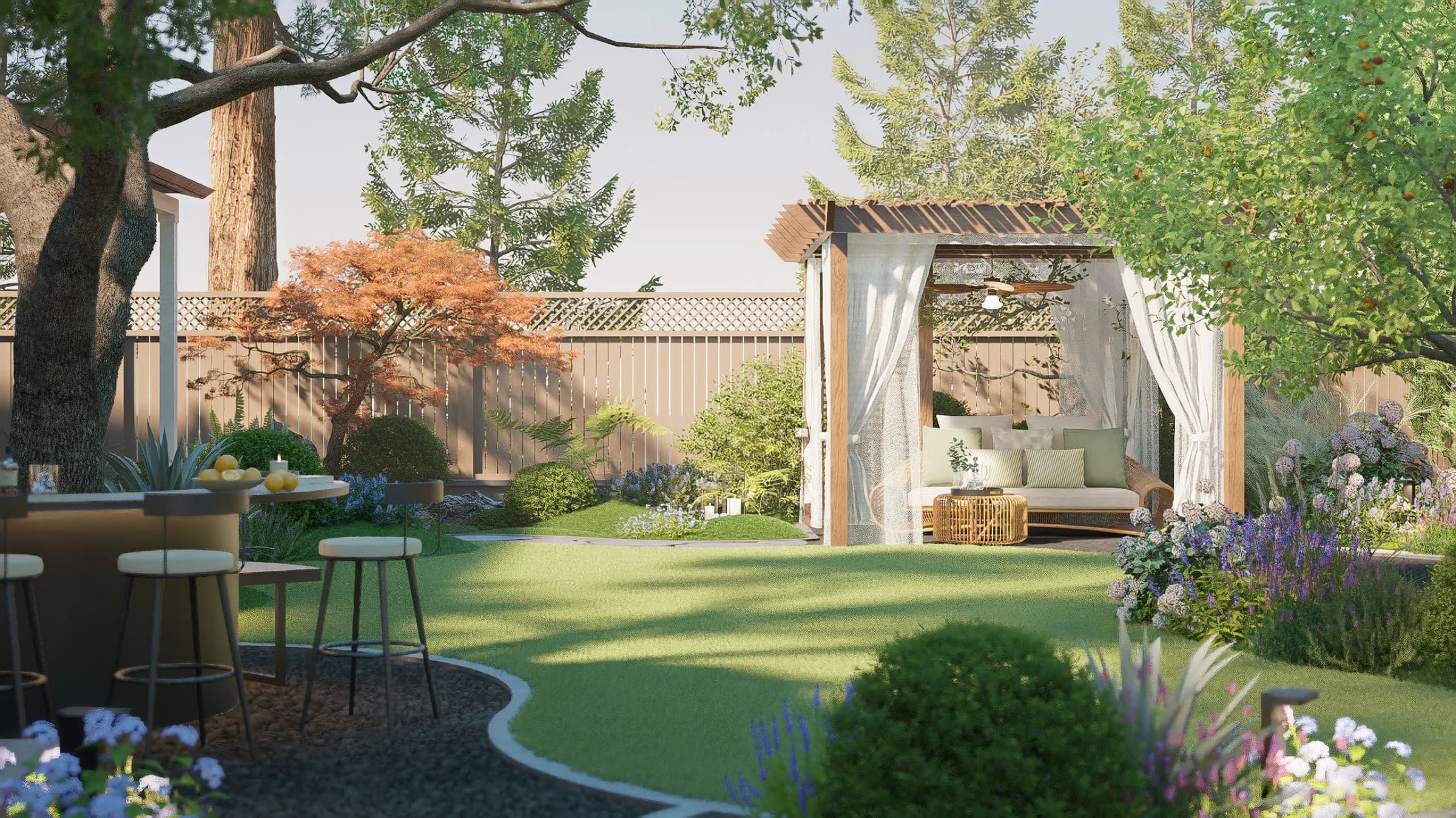
The short answer
In 2026 a Bay Area backyard remodel runs from about $10,000 for a refresh that keeps the existing patio and adds planting and paths, to $100,000 or more once there is a pool or a full outdoor kitchen. The national benchmark for a complete backyard renovation is $15,000–$50,000; the Bay Area sits above it because labor costs more here, lots are often on a slope, and access through a side gate limits what machines can do. For a typical 1,000-square-foot yard we find that most full remodels, the kind with a new patio, a planting plan, irrigation and lighting, land between $25,000 and $55,000 built, plus design.
Design is the small number. Our packages are fixed-price, $999 to $3,499, against a national average of about $4,200 for a landscape design. More on that below.
Where the money goes: Bay Area prices per square foot
Almost everything in a backyard is priced by area, so the fastest way to estimate a remodel is to decide how many square feet of each surface you want. The figures below are installed prices for the Bay Area in 2026 unless marked national; the sources are at the end.
| Element | Installed cost (2026) | What it means for the design |
|---|---|---|
| Gravel or decomposed granite path | $2–$7 per sq ft (national) | The cheapest surface by a wide margin, and the one that makes a garden feel like a garden. We use it for secondary paths, seating areas under trees and the space between planting. |
| Concrete patio | $10–$18 per sq ft | Plain poured concrete is still the budget hardscape. Stamped or decorative concrete is $15–$30. |
| Pavers | $18–$45 per sq ft | The range is wide because base preparation, drainage, cutting and the paver itself all vary. A 300-square-foot paver terrace is $5,400–$13,500. |
| Wood deck | $30–$80 per sq ft | Decks cost more than patios and need maintenance, but they solve a grade change without a retaining wall. |
| Composite deck | $40–$100 per sq ft | The most expensive surface per square foot. Worth it for a small area you will use every day; rarely worth it for a large one. |
| Planting | $3,000–$8,000 simple; $15,000+ layered | Shrubs, perennials and mulch at the low end; larger trees, a full planting plan and specimen plants at the top. Individual trees are $120–$2,500 each, so a few well-chosen trees go a long way. |
| Irrigation | $1,700–$3,550 (national) | Drip irrigation on separate zones is also a condition of every rebate below. |
| Landscape lighting | About $3,500 (national average) | Low-voltage lighting is the last item installed and the first one cut, which is a mistake; it is what makes the garden usable after work. |
| Pergola | $2,100–$6,000 (national) | A kit or simple timber pergola. A custom built one in the Bay Area is more, and it usually needs a permit. |
| Retaining wall | $3,250–$9,000 (national) | Sloped lots, which are common on the Peninsula and in the East Bay hills, often need one. Walls over four feet need an engineer. |
| Outdoor kitchen | $10,000–$100,000 | A simple BBQ island at the low end; sinks, refrigeration and a pizza oven at the top. This single item can double a budget. |
Two things these tables leave out. First, demolition and haul-away: removing an old concrete slab and a lawn through a side gate is paid by the hour and the truckload, and in the Bay Area that hour is expensive. Second, contingency: the Bay Area guide we cite recommends holding 10–20% for surprises, and so do we. Old irrigation lines, buried concrete and roots are the usual ones.
Three budgets for the same 1,000-square-foot yard
To make the ranges concrete, here is the same ordinary backyard, about 1,000 square feet behind a single-family house, remodeled three ways. These are our arithmetic from the per-unit prices above, not quotes; a contractor’s bid for your site will differ, and should.
Budget 1: the refresh, about $8,000–$20,000 built
Keep the existing patio and fence. Remove the lawn (or most of it), add 250 square feet of decomposed-granite paths and a sitting spot under the tree ($500–$1,750), a simple planting plan with mulch ($3,000–$8,000), drip irrigation ($1,700–$3,550) and a modest run of lighting ($1,500–$3,500). With a contingency, that is roughly $8,000–$20,000, and in Santa Clara County or the East Bay a lawn-conversion rebate (below) can return $1,000–$2,000 of it. This is the budget where design matters most per dollar, because there is nothing to hide behind: the plan has to be right.
Budget 2: rebuild the ground plane, about $25,000–$55,000 built
This is the typical full remodel. A new 350-square-foot paver terrace by the house ($6,300–$15,750), decomposed-granite paths and a second sitting area ($500–$1,750), a layered planting plan with a few new trees ($8,000–$15,000 or more), irrigation ($1,700–$3,550), lighting (about $3,500) and a simple pergola or shade structure ($2,100–$6,000). Add 10–20% contingency and the range is $25,000–$55,000. Where it lands inside that range is mostly the paver choice and how much planting you install at full size versus let grow in.
Budget 3: outdoor rooms, $50,000–$110,000 and up
Everything in Budget 2, plus a 300-square-foot composite deck off the kitchen ($12,000–$30,000), an outdoor kitchen ($10,000–$30,000 for a serious island, far more for a full kitchen), and on a sloped lot a retaining wall ($3,250–$9,000). That is $50,000–$110,000 before a pool; the Bay Area guide puts anything built around a pool north of $75,000 on its own. At this level permits, engineering and a longer schedule are part of the cost, and the design has to be drawn well enough to get through plan check.
Why the Bay Area costs more, and what to do about it
- Labor. Skilled landscape labor in the Bay Area is among the most expensive in the country, and hardscape is mostly labor. The way to spend less on labor is to design less hard surface: a 250-square-foot terrace you actually fill, with gravel and planting around it, costs a fraction of a 600-square-foot slab you never use the edges of.
- Slopes and access. Many lots in Menlo Park, Saratoga, Los Altos Hills and the Oakland and Berkeley hills have a grade change, and most are reached through a side gate. Work that would be done with a skid steer elsewhere is done by hand here. A design that works with the existing grade, and keeps the heavy materials near the gate, saves real money.
- Trees. Mature oaks and redwoods are the Bay Area’s great asset. Keeping them saves the cost of shade structures and years of waiting, but many cities protect them and require permits and root-zone rules. We design around protected trees rather than through them.
- Phasing. A good plan can be built in two or three phases without rework: ground plane and irrigation first, planting and lighting next, the pergola or kitchen when the budget allows. We draw the whole design so that each phase is complete on its own.
- Plant size. Buying plants in 1-gallon and 5-gallon sizes instead of 15-gallon can cut a planting budget by half. In this climate most shrubs and perennials catch up within two seasons; the trees are where larger sizes are worth paying for.
Rebates for taking out the lawn
Most Bay Area water agencies pay you to replace lawn with low-water planting, and the amounts are large enough to change a Budget 1 decision.
- Valley Water (Santa Clara County): $2 per square foot of converted lawn, up to $3,000 for a home, and up to $6,000 in cost-sharing areas. A pre-inspection and written approval are required before any work starts.
- EBMUD (East Bay): $1 per square foot, or $2 per square foot for the “super” rebate (mostly California natives, sheet mulching instead of removal, planting between September and February), up to $2,000 per single-family home. Apply and wait for approval before touching the lawn; the project then has nine months to finish.
- Elsewhere in the Bay Area: San Francisco, the Peninsula and Marin agencies run their own programs with different rates; check yours before you plan the demolition.
The conditions are similar everywhere: no artificial turf, drip irrigation on a pressure regulator, a minimum of plant cover when mature, and three inches of mulch. We design to these rules by default, and the application happens during design, because every agency refuses projects that started before approval.
Who is allowed to build it
In California, since January 1, 2025, anyone who contracts for a job worth more than $1,000 in labor and materials must hold a license from the Contractors State License Board; landscape work is the C-27 classification. The small-job exemption disappears entirely if the work needs a permit or if the person hires anyone to help, so in practice every backyard remodel on this page requires a licensed contractor. You can check any license number on the CSLB website in a minute, and you should.
Our role is the design. In the San Francisco Bay Area the garden can be built with licensed contractors we work with, from our drawings; elsewhere, the design package is drawn so that a local licensed contractor can price and build it. Either way you contract with the builder directly, and the drawings are detailed enough, down to the paver pattern, the drip zones and the section through the water feature, that bids come back comparable and surprises stay in the contingency.
What design costs, and what it saves
A landscape design in the United States averages about $4,200, with most homeowners paying $2,200–$6,180 and designers charging $50–$150 an hour. Ours is fixed-price: Back Yard $1,999, Front Yard $1,999, Full Yard $3,499, Small Space $999. Each includes the layout, 3D studies, planting and material direction, and a design review together. First design in 5–10 business days. Unlimited revisions until you love it — within the scope of your package. Everything is delivered online, anywhere in the United States or Canada.
On a $40,000 build, the design is about 5% of the project. It is also the only part of the project that decides what the other 95% buys: how much hard surface there is, whether the trees stay, which plants are bought small, and whether the rebate paperwork is in before the lawn comes out. The most expensive backyard is the one that gets built twice.
A worked example: The Garden Loop
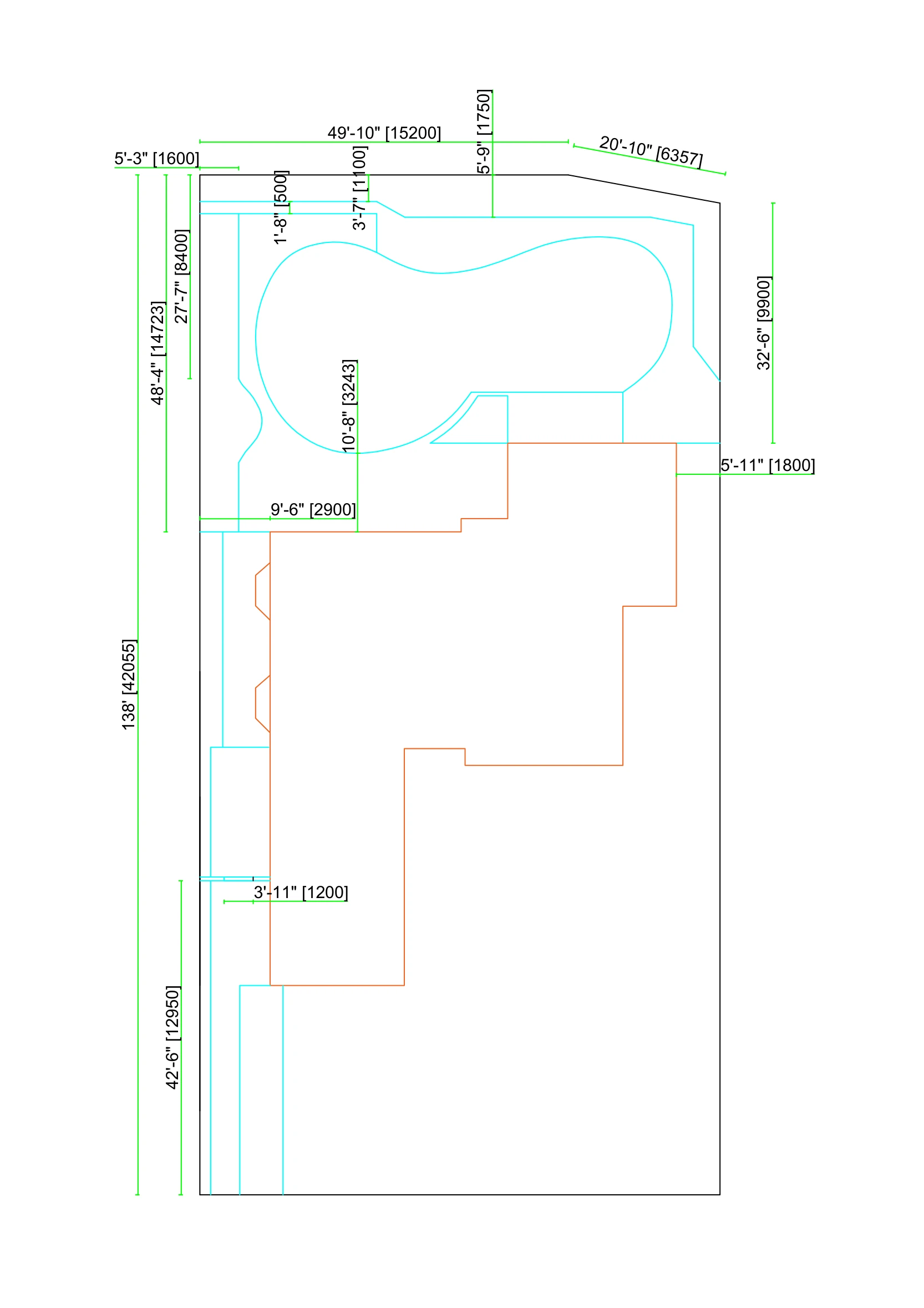
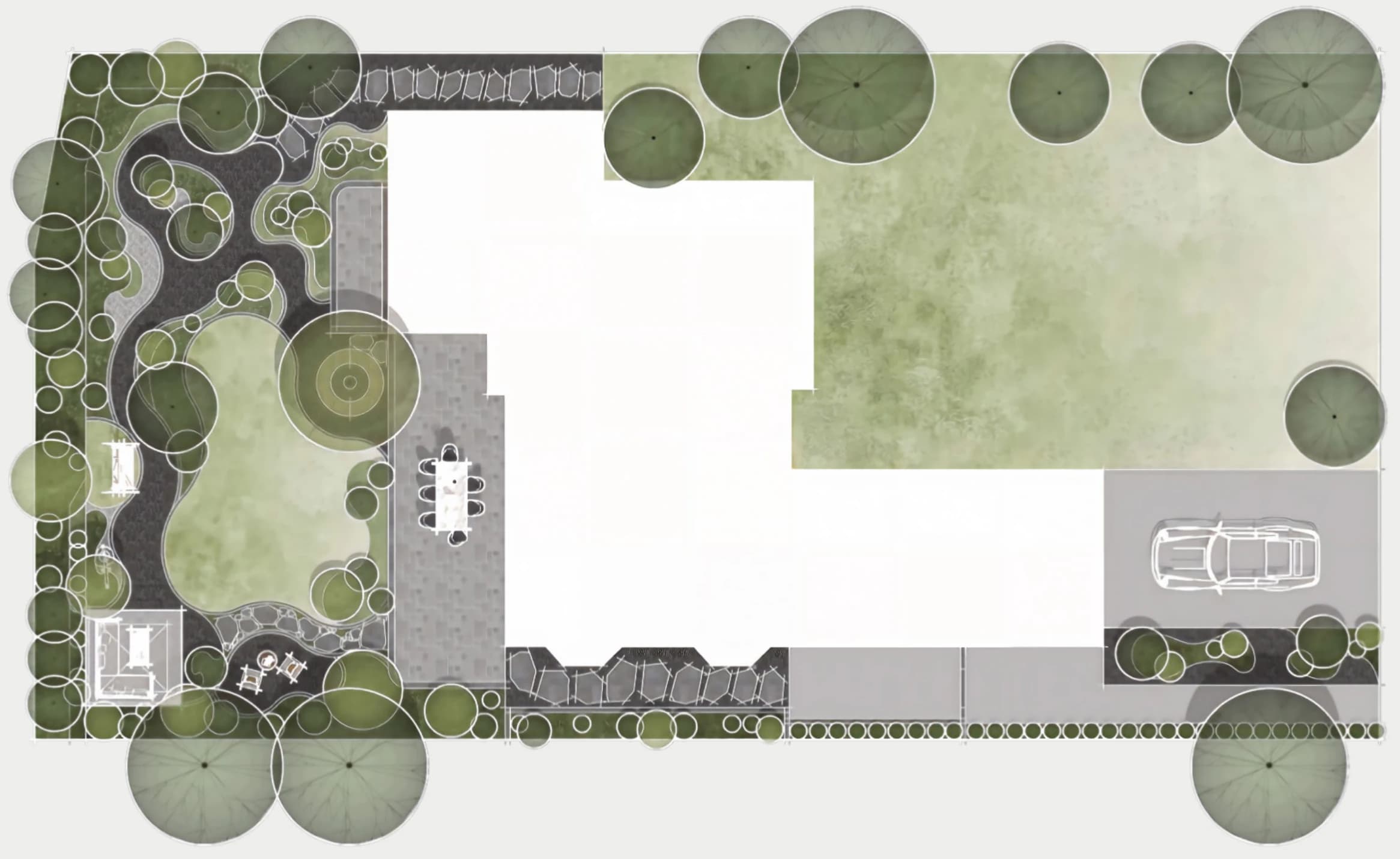
A backyard and side yard in Menlo Park, with an open lawn the family wanted to keep for play and several mature trees worth keeping for everything else. The design made the lawn smaller and rounder, ran a path in a loop around it through layered planting, put a shaded pavilion at the lawn’s edge and a table around one of the existing trees, and turned the side passage into a planted route rather than a corridor. In the terms of this article it is a Budget 2 project: new ground plane and planting, one structure, no kitchen, no pool, and the existing trees doing the work that a pergola budget would otherwise do.
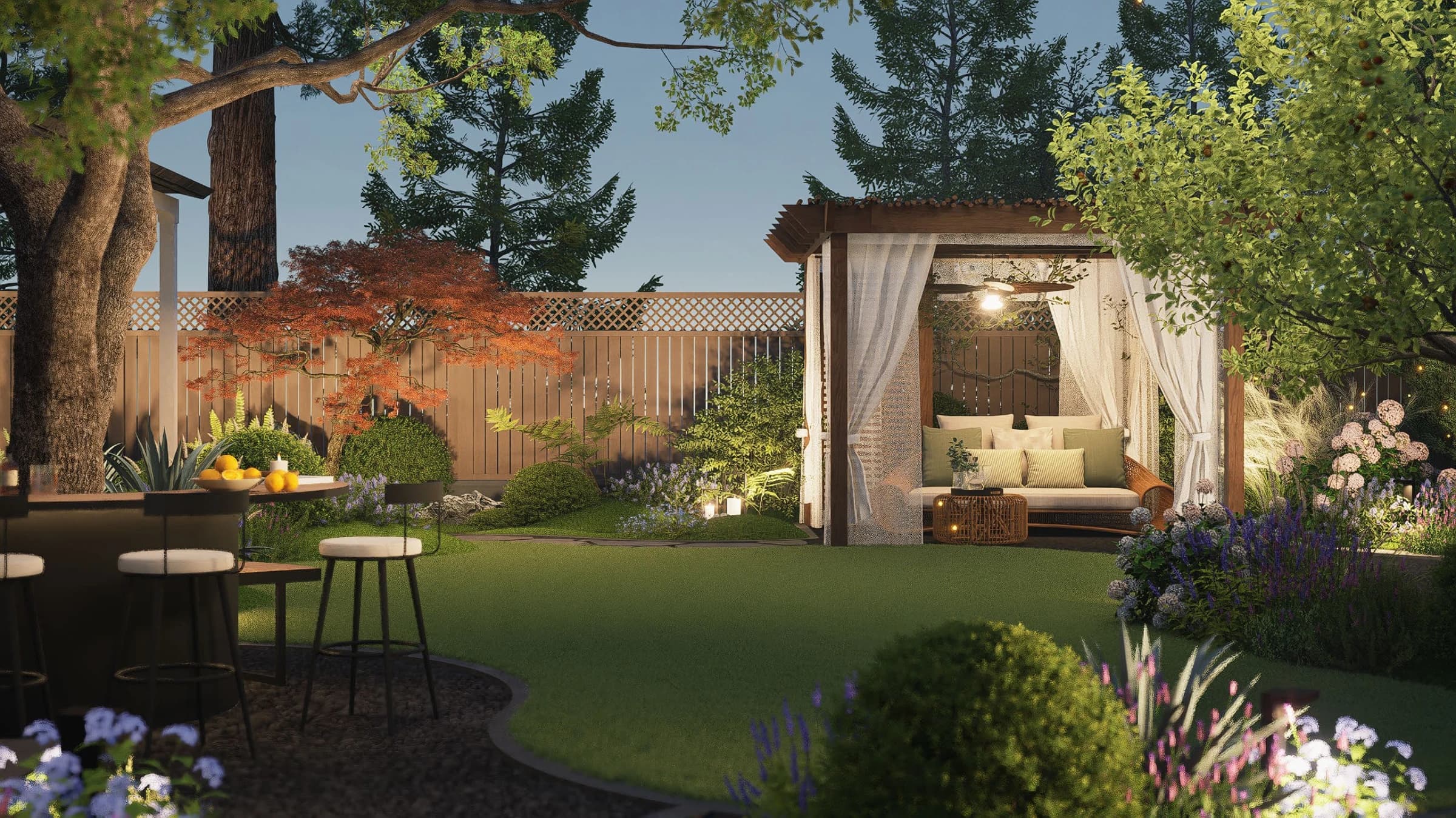
See the full project, including the plan and the side passage.
Questions people ask
- How much does a backyard remodel cost in the Bay Area?
- In 2026, a Bay Area backyard remodel runs from about $10,000 for a planting-and-paths refresh to $100,000 or more with a pool or outdoor kitchen. Most full remodels of a typical 1,000-square-foot yard land between $25,000 and $55,000 built, plus design. Labor, hillside lots and tight access push Bay Area prices above the national $15,000–$50,000 benchmark.
- What does hardscape cost per square foot in the Bay Area?
- Installed, in 2026: concrete patio $10–$18 per square foot, stamped concrete $15–$30, pavers $18–$45, wood decking $30–$80 and composite decking $40–$100. Gravel or decomposed granite paths are the cheapest surface at roughly $2–$7 per square foot, which is why we use them generously.
- Are there rebates for replacing a lawn in the Bay Area?
- Yes. Valley Water (Santa Clara County) pays $2 per square foot of converted lawn, up to $3,000 for a home. EBMUD (East Bay) pays $1 per square foot, or $2 with native plants and sheet mulching, up to $2,000. Both require approval before any work starts, so apply during design, not after demolition.
- Do I need a licensed contractor for a backyard remodel in California?
- Yes for almost any remodel. Since January 2025, any job over $1,000 in labor and materials, any job that needs a permit, and any job where the person hires workers requires a contractor licensed by the CSLB; landscape work is the C-27 classification. We design the garden; in the Bay Area it is built with licensed contractors from our drawings.
START WITH YOUR SPACE
Find out what your yard could be.
A short quiz about your space and your budget, then a design conversation with Peilin. Fixed-price packages from $999 for a courtyard to $1,999 for a backyard.
SOURCES
- GreatBuildz, "Bay Area Backyard Remodel Cost Guide" (updated October 16, 2026): $10,000–$100,000+ overall; per square foot, concrete patio $10–$18, stamped concrete $15–$30, pavers $18–$45, wood decking $30–$80, composite decking $40–$100; simple plantings $3,000–$8,000, complex gardens $15,000+; outdoor kitchens $10,000–$100,000; keep 10–20% for surprises. greatbuildz.com
- HomeAdvisor, "How Much Does Landscaping Cost?" (updated June 19, 2026): $4.50–$12 per square foot typical, up to $40 for full tear-outs; full backyard renovation $15,000–$50,000; sprinkler installation $1,700–$3,550; retaining wall $3,250–$9,000; trees $120–$2,500 each. homeadvisor.com
- LawnLove, "How Much Does a Patio Cost?" (updated December 27, 2025, national figures): gravel $2–$7 per square foot; pavers $8–$25; flagstone $8–$35; landscape lighting about $3,500; pergola $2,100–$6,000. lawnlove.com
- LawnStarter, "How Much Does Landscape Design Cost?" (updated December 27, 2025): national average $4,200, typical $2,200–$6,180; designers $50–$150 per hour. lawnstarter.com
- Valley Water (Santa Clara County), Landscape Conversion Rebate: $2 per square foot, up to $3,000 for a home ($6,000 in cost-sharing areas); pre-inspection and written approval before any work. valleywater.org
- EBMUD (East Bay), Lawn Conversion Rebate: $1 per square foot standard, $2 "super" rebate with native plants and sheet mulching; up to $2,000 per single-family home in two years; approval before work, nine months to complete. ebmud.com
- Contractors State License Board, Industry Bulletin 24-07 (December 31, 2024): from January 1, 2025 the unlicensed "minor work" exemption rises to $1,000, but not if the job needs a permit or the person hires any workers. cslb.ca.gov