JOURNAL / FRONT YARDS
Drought-tolerant front yard design for the Bay Area: a lawn replacement plan, the plants, and the rebates.
The front yard is the part of a garden that everyone sees and almost nobody uses. In the Bay Area a front lawn costs money twice, once in water and once in mowing, and your water agency will pay you to take it out. The trouble is that most lawn replacements look like a parking lot with cactus. Here is how we design one that reads as a garden from the street: the plan, the plants that work from San Jose to Marin, what it costs in 2026, and how to collect the rebate before the first shovel goes in.
The short answer
A drought-tolerant front yard is a planting design, not a gravel delivery. Replace the lawn with three layers: a ground plane of decomposed granite, mulch or a low sedge meadow; a few evergreen structure plants (manzanita, ceanothus, toyon, a small tree); and seasonal color from salvias, California fuchsia and yarrow, all on drip irrigation. Installed, that runs about $5–$20 per square foot nationally, so a typical 500-square-foot front lawn is roughly $3,500–$9,000 and a 1,000-square-foot one $7,000–$18,000; Bay Area labor puts most projects in the upper half. Rebates of $1–$4 per square foot come back from Valley Water, EBMUD, BAWSCA cities or Marin Water, as long as you apply before you remove anything.
The payoff is not only the water bill, although landscape irrigation is about half of a California home’s water use. It is a front garden that is green in August, has something in flower most months, and is finished in a season instead of being mowed forever.
Why the front yard is the place to start
- It is the lawn you never walk on. Backyard lawns earn their water with children and dogs. Front lawns are mostly looked at, so they are the first to go and the easiest to replace well.
- It is the smallest, most visible project on the property. A front yard makeover is usually a few hundred to a thousand square feet, it is done in weeks, and it changes how the house reads from the street every day after.
- The rebate math works best here. Agencies pay per square foot of lawn removed, with a cap. A front lawn often fits entirely under the cap, so the rebate covers a real share of the cost rather than a sliver.
- It is phase one of everything else. If you are planning a whole-property design, the front yard is the part you can build first without touching the backyard, and our Full Yard package draws it that way.
The plan: five moves, in the order we draw them
1. Fix the walk before you touch a plant
Most front yards have a path that was poured with the house: straight, narrow, and aimed at the driveway rather than the street. We decide first whether it stays. A path four feet wide, running where people actually walk, with a landing at the door, does more for the front of a house than any plant will. If the existing concrete is sound and in the right place, keep it and spend the money on planting; if not, replace it with pavers or a decomposed-granite walk with steel edging, which is cheaper, drains, and looks right with low-water planting.
2. Replace the lawn with three layers, not one
The mistake in most lawn replacements is a single layer: a sheet of bark or gravel with plants dotted in it. A garden has a ground plane, structure, and seasonal change.
- Ground plane. Decomposed granite or gravel where you walk or want open space; three inches of mulch under the planting; or, where the lawn feeling matters, a meadow of native sedge (Carex praegracilis) that is mown twice a year and watered a fraction of a lawn.
- Structure. Two or three evergreen shrubs placed to frame the door and screen the neighbor’s driveway, and one small tree if there is room. These are the plants you see in January.
- Seasonal layer. Perennials, grasses and bulbs in drifts of five to nine, not one of each. Repeat three or four kinds across the yard and it reads as a design rather than a collection.
3. Hold the street edge
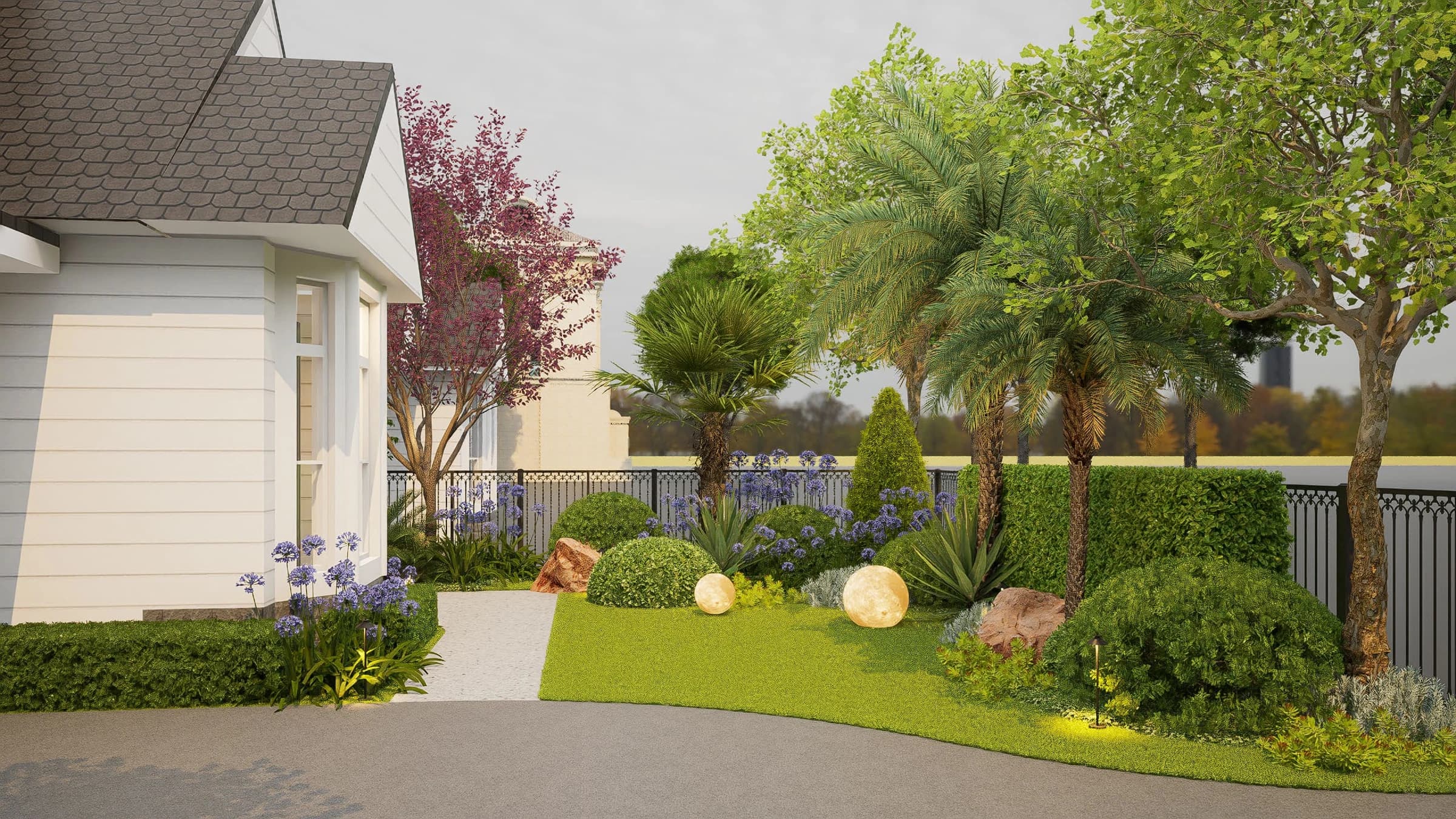
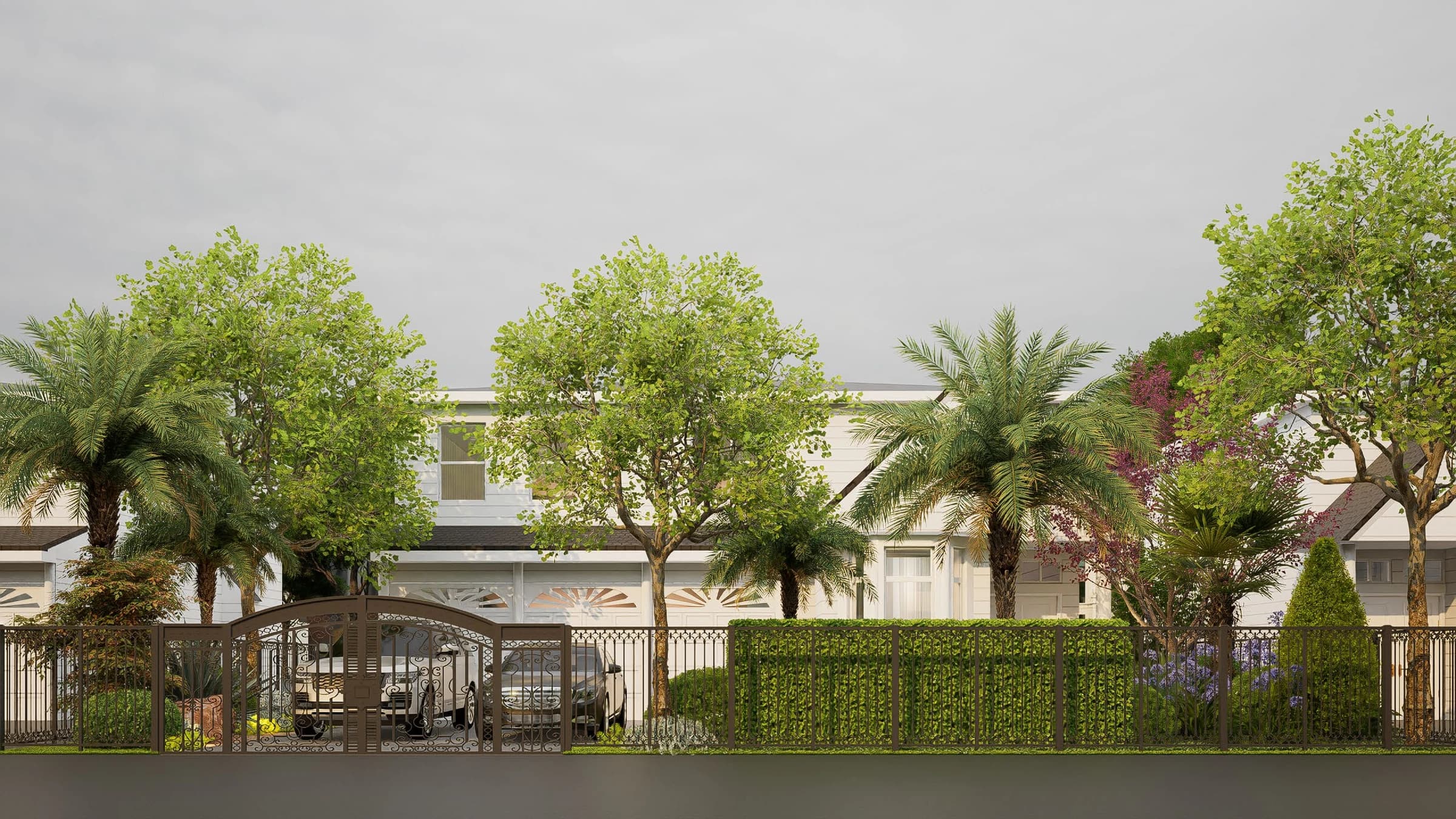
A lawn gives a front yard a clean edge; take it away and the yard can dissolve into the sidewalk. A low clipped hedge, a run of steel or stone edging, a short fence or a change of surface restores the line. In the Saratoga garden above it is ironwork and clipped evergreens; on a smaller lot it can be a single row of dwarf olive or westringia.
4. Water by drip, on a schedule that gets shorter
Drip irrigation on a pressure regulator with a weather-based controller is a condition of every rebate below and the reason the planting survives its first two summers. Low-water plants are not no-water plants until they are established: deep watering every week or two in the first dry season, then every two to four weeks, then for many natives nothing at all. We zone the drip so the tree, the shrubs and the seasonal layer can be watered differently, because they want to be.
5. Sheet-mulch the lawn instead of hauling it away
Cardboard over the mown lawn, compost and mulch on top, and the grass is gone by spring with no truckloads leaving through the gate. EBMUD pays a higher rebate for exactly this. It also keeps the soil structure a lawn has spent years building, which the new plants will use.
Plants that work from San Jose to Marin
The Bay Area is several climates. San Francisco, Daly City and the coast get fog and cool summers; San Jose, Walnut Creek and the inland valleys get hot, dry afternoons; the Peninsula and Marin sit in between, often on clay. The plants below handle most of that range with little water once established. We pick from the UC Davis Arboretum All-Stars (plants tested in the arboretum, most on deep watering about every two weeks in summer) and from Calscape, the California Native Plant Society’s tool that lists natives for your exact location, then check each one against your exposure and soil.
| Role | Plants | Notes for the Bay Area |
|---|---|---|
| Small tree | Western redbud; strawberry tree ‘Marina’; fruitless olive ‘Swan Hill’; coast live oak where there is room | One tree, placed to shade the walk or the west-facing window. An oak is a 50-year decision and many cities protect it once it is established; that is a feature, not a problem. |
| Evergreen structure | Manzanita (‘Howard McMinn’, ‘Dr. Hurd’, ‘John Dourley’); ceanothus (‘Yankee Point’, ‘Ray Hartman’); toyon; coast rosemary (westringia) | Manzanita and ceanothus want drainage and no summer water once established; on heavy clay choose the cultivars sold for it and plant high. Toyon takes clay and shade and feeds the birds. |
| Seasonal layer | Salvia ‘Bee’s Bliss’ and other sages; California fuchsia ‘Everett’s Choice’; yarrow; deer grass; lomandra ‘Platinum Beauty’; lavender and santolina in hot, sunny spots | Plant in drifts of five to nine. California fuchsia flowers in late summer when little else does and the hummingbirds find it the same week. |
| Lawn feeling without the lawn | Native sedge meadow (Carex praegracilis); dymondia or kurapia as a flat groundcover between pavers | A sedge meadow is the answer for the family that wants somewhere green to stand. It is mown a few times a year and needs a fraction of a lawn’s water; it is still not zero. |
| Under the planting | Three inches of mulch; decomposed granite or gravel where you walk | Mulch is a rebate condition everywhere and the cheapest thing on the plant list. Gravel is for paths and seating, not as a blanket over the whole yard. |
Two cautions. Coastal gardens can grow many of these with no summer water at all; inland gardens need the drip for longer and benefit from afternoon shade on the seasonal layer. And every plant on this list is sold in 1-gallon and 5-gallon sizes; buying small is the single biggest saving in a planting budget, and in this climate most shrubs catch up within two seasons.
What it costs: a worked budget for a 600-square-foot front lawn
The national figures for xeriscaping are $5–$20 per square foot installed, which gives $3,500–$9,165 for 500 square feet and $7,000–$18,330 for 1,000. Here is how that breaks down for an ordinary 600-square-foot Bay Area front lawn, using the per-item prices in the sources. These are our arithmetic, not a quote; a contractor’s bid for your site will differ, and should.
| Item | Basis | Estimate |
|---|---|---|
| Lawn removal | Sheet mulching with cardboard and compost, or cutting and hauling | $600–$2,000 |
| Decomposed-granite walk and a small sitting spot, 120 sq ft | $2–$7 per sq ft | $250–$850 |
| Steel edging and a low hedge at the street | Edging plus 12–15 small shrubs | $600–$1,500 |
| One small tree, planted | $150–$1,850 each | $300–$1,200 |
| Structure shrubs and seasonal planting, about 60–80 plants | Shrubs $12–$90, perennials less, bought small | $1,500–$4,000 |
| Drip irrigation on a regulator, with a weather-based controller | $1.70–$4.80 per sq ft | $1,000–$2,900 |
| Mulch, 3 inches over about 480 sq ft | About 4.5 cubic yards at $30–$110, plus spreading | $300–$900 |
| Path and entry lighting, a short run | Low-voltage, 4–6 fixtures | $800–$2,000 |
| Built, before contingency | about $5,400–$15,000 | |
| Rebate on 600 sq ft of lawn | $1–$4 per sq ft, by agency | minus $600–$2,400 |
Hold 10–15% for surprises; in a front yard they are usually old sprinkler lines and tree roots. The design fee is separate and fixed: our Front Yard package is $1,999 and covers exactly this scope, from the street edge to the door, with the plan drawn so a contractor can price it line by line.
The rebates, agency by agency
Every Bay Area agency pays per square foot of living lawn removed, and every one of them refuses projects that started before approval. The application happens during design, with a plan and a plant list, which is one reason to have the plan first.
| Agency | Rebate (2026) | Cap and conditions |
|---|---|---|
| Valley Water (Santa Clara County: San Jose, Sunnyvale, Palo Alto, Saratoga, Los Altos, Cupertino) | $2 per sq ft | Up to $3,000 for a home ($6,000 in cost-sharing areas). Pre-inspection and written approval before any work. |
| EBMUD (Oakland, Berkeley, Walnut Creek, Lafayette, Orinda and the East Bay) | $1 per sq ft; $2 “super” rebate | Up to $2,000 per single-family home in two years. The $2 rate needs mostly California natives, sheet mulching and planting between September and February; plants must cover half the area when mature. |
| BAWSCA Lawn Be Gone! (participating Peninsula and Alameda County cities: Menlo Park, Burlingame, San Mateo, Redwood City, Hayward and others) | Up to $4 per sq ft, set by each city | Plus $300 for a rain garden. A Notice to Proceed from your water provider before removing the lawn; FY 2026–27 application. Rates and caps are set city by city: Burlingame, for example, lists $2 per sq ft up to $500. |
| Marin Water (central and southern Marin) | $2.18 per sq ft; $3.68 best-practices; $4.68 with a rain garden | Rates in effect since January 2025; site survey before conversion. |
| San Francisco | No per-square-foot lawn rebate that we could find | SFPUC runs other conservation programs; check before you count on one. Coastal gardens also need the least irrigation of anywhere on this list. |
The conditions are nearly the same everywhere: a minimum area (often 200–250 square feet), no artificial turf, drip irrigation on a pressure regulator, a minimum plant cover at maturity, three inches of mulch, and photographs before and after. We design to these rules by default, so the plan we hand you is also the plan you submit.
The rules, in one paragraph each
Permits. A planting-and-path makeover without new structures, grading or a retaining wall does not normally need a building permit. California’s water-efficient landscape ordinance (MWELO) applies to projects that need a permit and cover more than 500 square feet of new landscape; where it does apply, it limits turf to 25% of a residential landscape and expects drip, mulch and climate-adapted plants, which a drought-tolerant design meets without trying.
The turf ban. AB 1572, the law that ends irrigation of “nonfunctional” lawn with drinking water from 2027, applies to commercial, industrial and institutional properties and HOA common areas. It does not apply to single-family homes. Your front lawn is legal; it is just expensive.
Who installs it. Since January 2025, any job over $1,000 in labor and materials, any job that needs a permit, and any job where the person hires workers requires a contractor licensed by the CSLB; landscape work is the C-27 classification. Our role is the design. In the Bay Area the garden can be built with licensed contractors we work with, from our drawings; elsewhere the package is drawn so a local licensed contractor can price and build it. Either way you contract with the builder directly.
A worked example: Through the Rose Arches
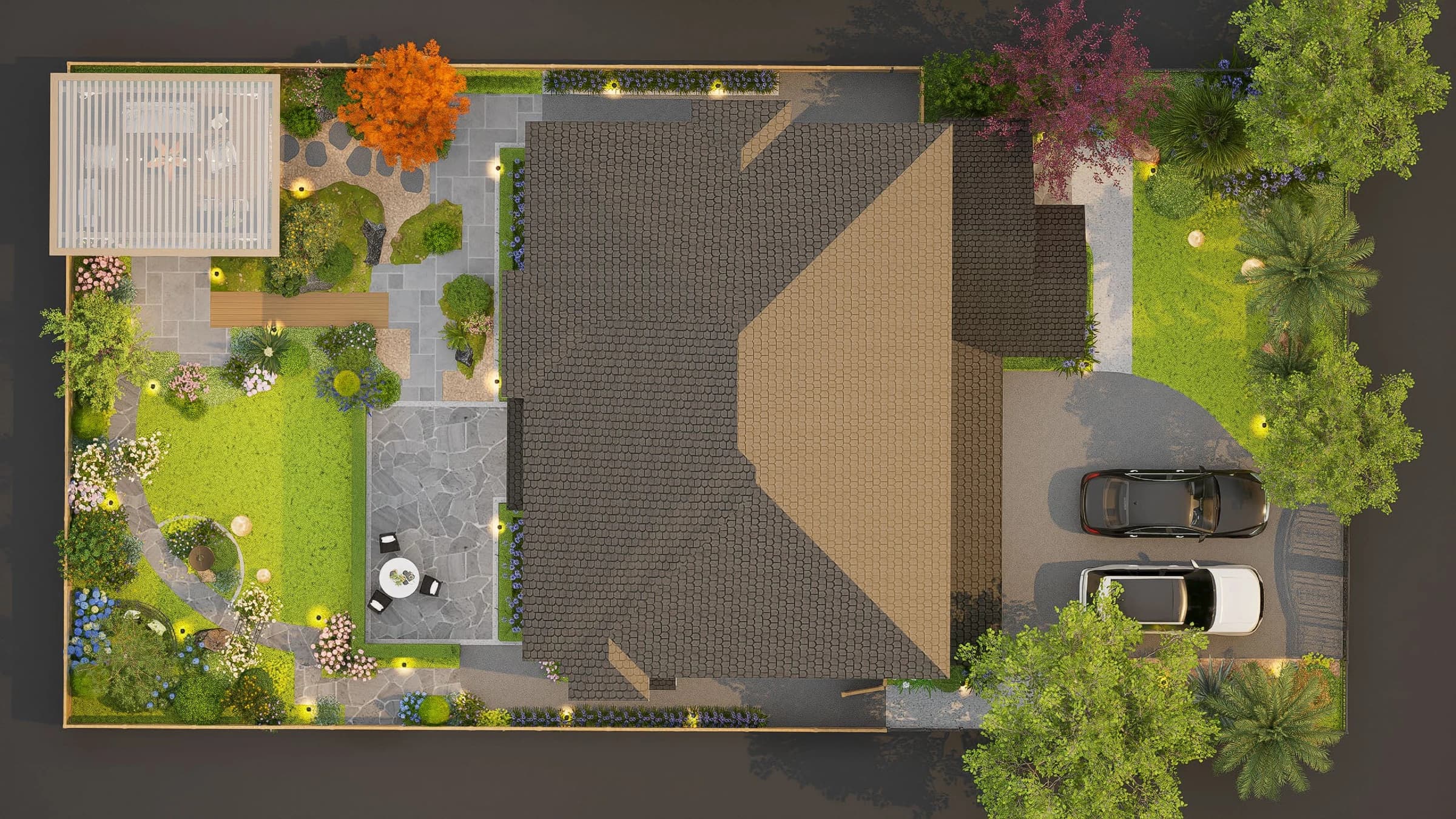
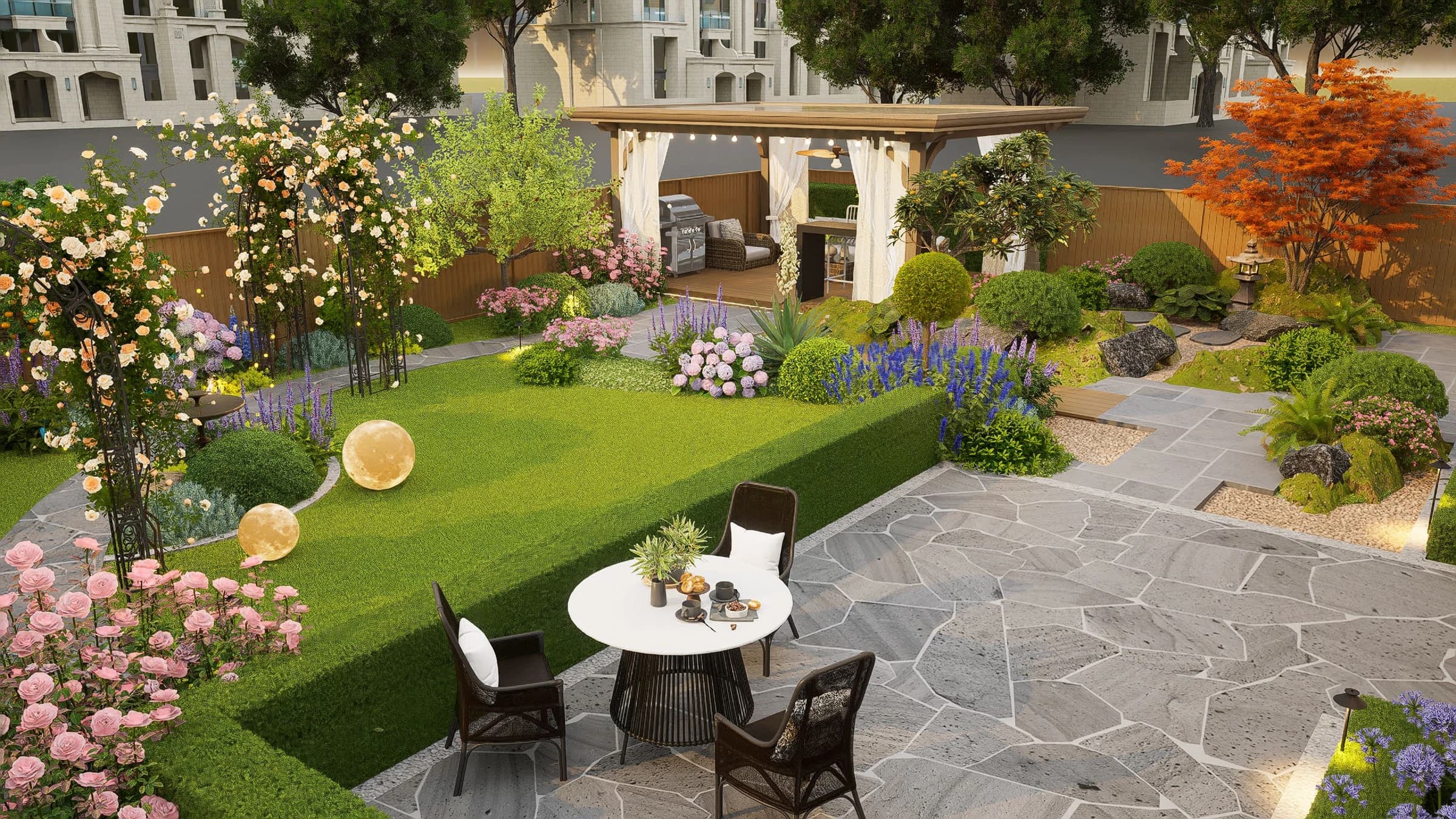
A whole-property design in Saratoga, where the homeowners wanted a garden that felt more inviting and easier to move through. The front garden has to do two jobs at once: hold the practical space of the driveway and make arriving home feel like entering a garden. The proposal frames the house with iron fencing, clipped hedges and layered foliage at the street, and runs planting along the entry path so the garden comes right up to the everyday walk to the door. Low-water, evergreen structure does the framing; the color is in the layer behind it. In the terms of this article it is moves 1 through 3 done together, and it is drawn as the first phase of a plan that continues through the side yard to a flowering walk and a pavilion at the back.
See the full project, including the arrival and the plan.
Questions people ask
- How much does it cost to replace a front lawn with drought-tolerant landscaping in the Bay Area?
- Nationally, xeriscaping runs $5–$20 per square foot installed, so a 500-square-foot front lawn is roughly $3,500–$9,000 and a 1,000-square-foot one $7,000–$18,000. Bay Area labor puts most projects in the upper half of those ranges. Water-agency rebates of $1–$4 per square foot return part of it, and a design that keeps the existing walk and uses gravel and mulch generously keeps the rest down.
- Which Bay Area water agencies pay you to remove a lawn?
- Valley Water (Santa Clara County) pays $2 per square foot, up to $3,000 for a home. EBMUD (East Bay) pays $1, or $2 with native plants and sheet mulching, up to $2,000. BAWSCA’s Lawn Be Gone program for Peninsula and Alameda County member cities pays up to $4 per square foot depending on the city, plus $300 for a rain garden. Marin Water pays $2.18, or $3.68 for a best-practices project. All of them require approval before the lawn comes out.
- What should I plant instead of a lawn in a Bay Area front yard?
- A mix of three layers: a ground plane of decomposed granite, mulch or a sedge meadow; a few evergreen structure plants such as manzanita, ceanothus or toyon; and seasonal color from salvias, California fuchsia and yarrow. Pick from the UC Davis Arboretum All-Stars or Calscape lists, and match the plants to your exposure: coastal fog in San Francisco and Daly City, hot afternoons in San Jose and Walnut Creek.
- Do I need a permit to replace my front lawn in California?
- Usually not. A planting-and-path makeover without new structures, grading or a retaining wall does not normally need a building permit, and the state water-efficient landscape rules apply only to projects that need one and cover more than 500 square feet of new landscape. The nonfunctional-turf law (AB 1572) applies to commercial, institutional and HOA common areas, not to single-family homes. Any installation over $1,000 must be done by a CSLB-licensed contractor, C-27 for landscape work.
START WITH YOUR FRONT YARD
A front garden instead of a front lawn.
The Front Yard package, $1,999, covers the street edge to your door: the walk, the planting plan, 3D studies and a design review together, drawn to your water agency’s rebate rules. First design in 5–10 business days. Unlimited revisions until you love it — within the scope of your package. Packages run from $999 for a courtyard to $3,499 for the whole property.
SOURCES
- LawnStarter, "How Much Does Xeriscaping Cost?" (updated December 27, 2025, national figures): $5–$20 per square foot installed; 500 sq ft $3,500–$9,165; 1,000 sq ft $7,000–$18,330; drip irrigation $1.70–$4.80 per square foot; mulch $30–$110 per cubic yard; shrubs $12–$90 each; trees $150–$1,850 planted. lawnstarter.com
- Valley Water (Santa Clara County), Landscape Conversion Rebate: $2 per square foot, up to $3,000 for a home ($6,000 in cost-sharing areas); pre-inspection and written approval before any work. valleywater.org
- EBMUD (East Bay), Lawn Conversion Rebate: $1 per square foot standard, $2 "super" rebate with native plants and sheet mulching; up to $2,000 per single-family home in two years; approval before work; plants must cover 50% of the area when mature. ebmud.com
- BAWSCA (Bay Area Water Supply and Conservation Agency), Lawn Be Gone! rebate for participating member cities on the Peninsula and in Alameda County: up to $4 per square foot, plus $300 for a rain garden; a Notice to Proceed is required before removing the lawn; FY 2026–27 application. Individual cities set their own rates and caps (Burlingame, for example, lists $2 per square foot up to $500). bawsca.org
- Marin Water, Cash for Grass (rates from January 1, 2025): $2.18 per square foot base, $3.68 for best-practices projects, $4.68 with a rain garden fed by disconnected downspouts. marinwater.org
- Hodel and Pittenger (University of California), "How landscape water use stacks up statewide", Landscape Management (2015, updated November 2023): landscape irrigation is about half of annual residential water use in California, about 30% in many coastal communities and 60% or more in inland suburbs. landscapemanagement.net
- UC Davis Arboretum, Arboretum All-Stars: plants grown and tested in the arboretum, chosen for low water, easy care and habitat value; most thrive on deep watering about once every two weeks in the dry season. Searchable plant database. arboretum.ucdavis.edu
- California Native Plant Society, Calscape: find native plants for your location, with nurseries, a garden planner and watering guides. calscape.org
- UC Master Gardener Program of Contra Costa County, Richmond Low Water Demo Garden and California Native Garden plant pages (manzanita cultivars, toyon, California fuchsia ‘Everett’s Choice’). ucanr.edu
- California Water Service, AB 1572 resources: the nonfunctional-turf irrigation ban applies to commercial, industrial, institutional and HOA common-area turf, with compliance dates from 2027; single-family homes are not covered. calwater.com
- San Joaquin County, Model Water Efficient Landscape Ordinance prescriptive method form: for residential projects the total turf area shall not exceed 25% of the landscape area; the ordinance applies to permitted new landscapes over 500 square feet. sjgov.org
- Contractors State License Board, Industry Bulletin 24-07 (December 31, 2024): from January 1, 2025 the unlicensed "minor work" exemption rises to $1,000, but not if the job needs a permit or the person hires any workers. cslb.ca.gov