JOURNAL / JAPANESE-INSPIRED GARDENS
Japanese-inspired garden design for California homes: 7 principles, plants and costs.
A Japanese-inspired garden works in California when you bring the principles and leave the props: borrowed views, a path that hides and reveals, empty space, a few well-set stones, a little water, and plants that can take a dry summer. Here is how we design them, what to plant, and what it costs.
The short answer
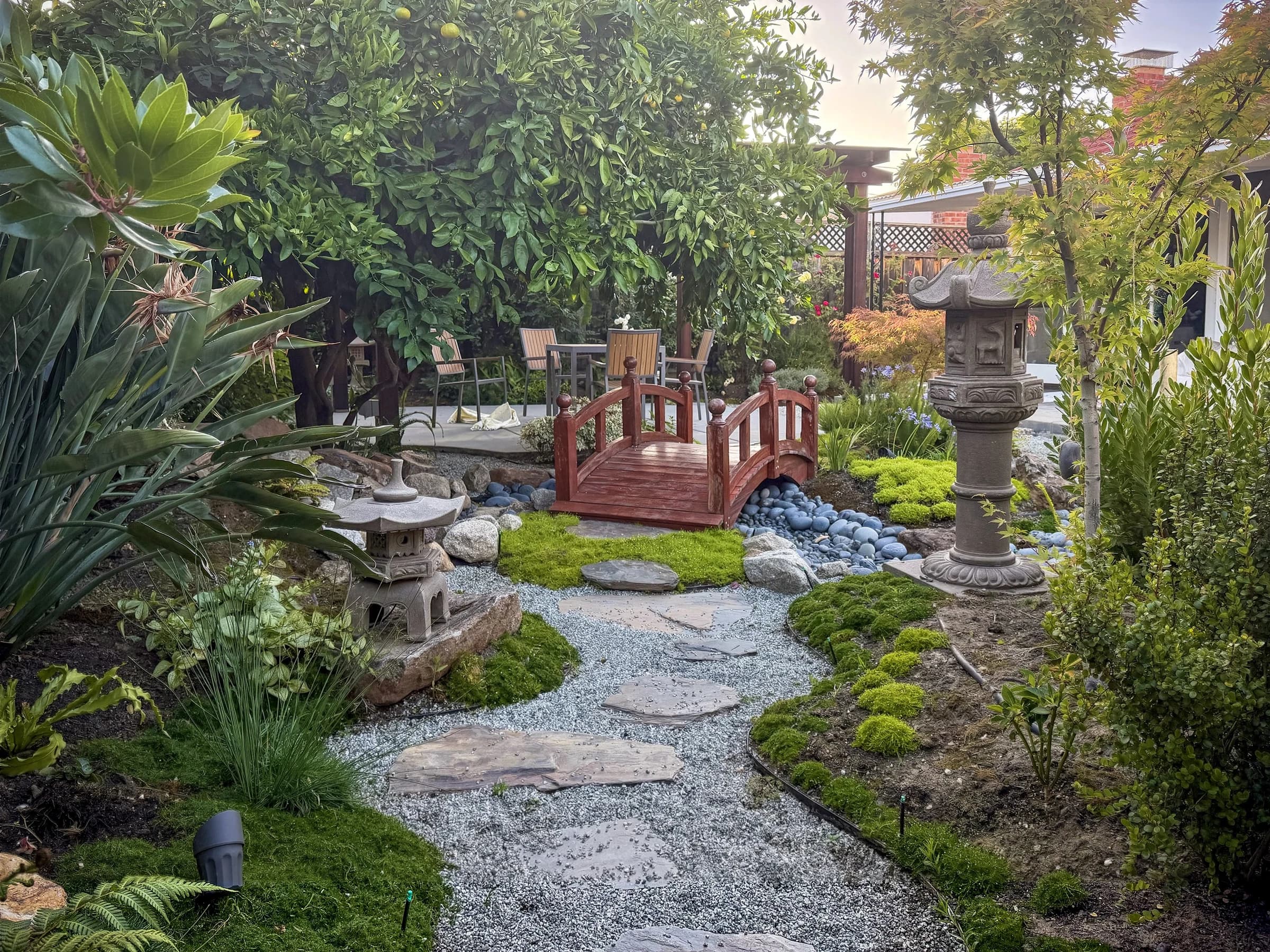
Most “Japanese gardens” in California fail for one of two reasons: they copy objects (a lantern, a red bridge, a bamboo fountain) without the ideas that give those objects meaning, or they plant a Kyoto palette of moss and maples into full sun and clay, and water it all summer. The gardens that work do the opposite. They borrow the structure of the tradition, which was developed for small, enclosed, walked-through spaces, and fill it with plants that like a Mediterranean climate.
Cost, in plain numbers: a complete design from us is a fixed $999 to $3,499 depending on how much of the property it covers. Construction is quoted separately. A national benchmark for a full backyard renovation is $15,000–$50,000; Japanese-inspired gardens sit toward the middle and top of that range because stone setting, water and carpentry are labor, not materials. In Santa Clara County, replacing lawn with a low-water garden currently earns a rebate of $2 per square foot. Details and sources are below.
Seven principles that survive the move to California
1. Borrowed scenery (shakkei): start with what is already there
The oldest trick in the tradition is to make the view beyond the fence part of the garden: a neighbor’s oak, the hills, the sky between two rooflines. In California yards the equivalent is usually the mature trees you already own. At The Quiet Crossing the client’s trees and an existing pergola gave the garden its ceiling and its shade; the design was made underneath them rather than around a cleared lot. Keeping a canopy is the single biggest saving in both money and years.
2. Hide and reveal (miegakure): never show the whole garden at once
A path that bends, a planted island that blocks the view for three steps, a bridge that makes you take the long way: these make a 1,200-square-foot yard feel like a walk. The rule is simple. From no single point should you see every part of the garden. This is also why the style suits small lots so well.
3. Asymmetry: odd numbers, off-center, never a mirror
Nothing is centered on the house. Stones are set in threes and fives, the water is off to one side, the specimen tree leans. Western symmetry reads as formal; asymmetry reads as found, as if the garden had been there first.
4. Ma, the empty space: gravel is not what is left over
The pauses are the design. A field of pale gravel, a plain stretch of decomposed granite, a low bed of one groundcover, these let the eye rest and make the planted moments count. In a dry climate, empty space is also the cheapest and most water-wise part of the garden, so use it generously and keep the planting to a few deliberate groups.
5. Stone as structure, not decoration
Stones are set, not scattered: buried a third of their height, grouped so one leads and the others follow, placed where a path turns or water starts. One good boulder, properly set, does more than a dozen loose ones. This is where a local contractor’s skill matters most and where we draw the most detail.
6. A little water, and the sound of it
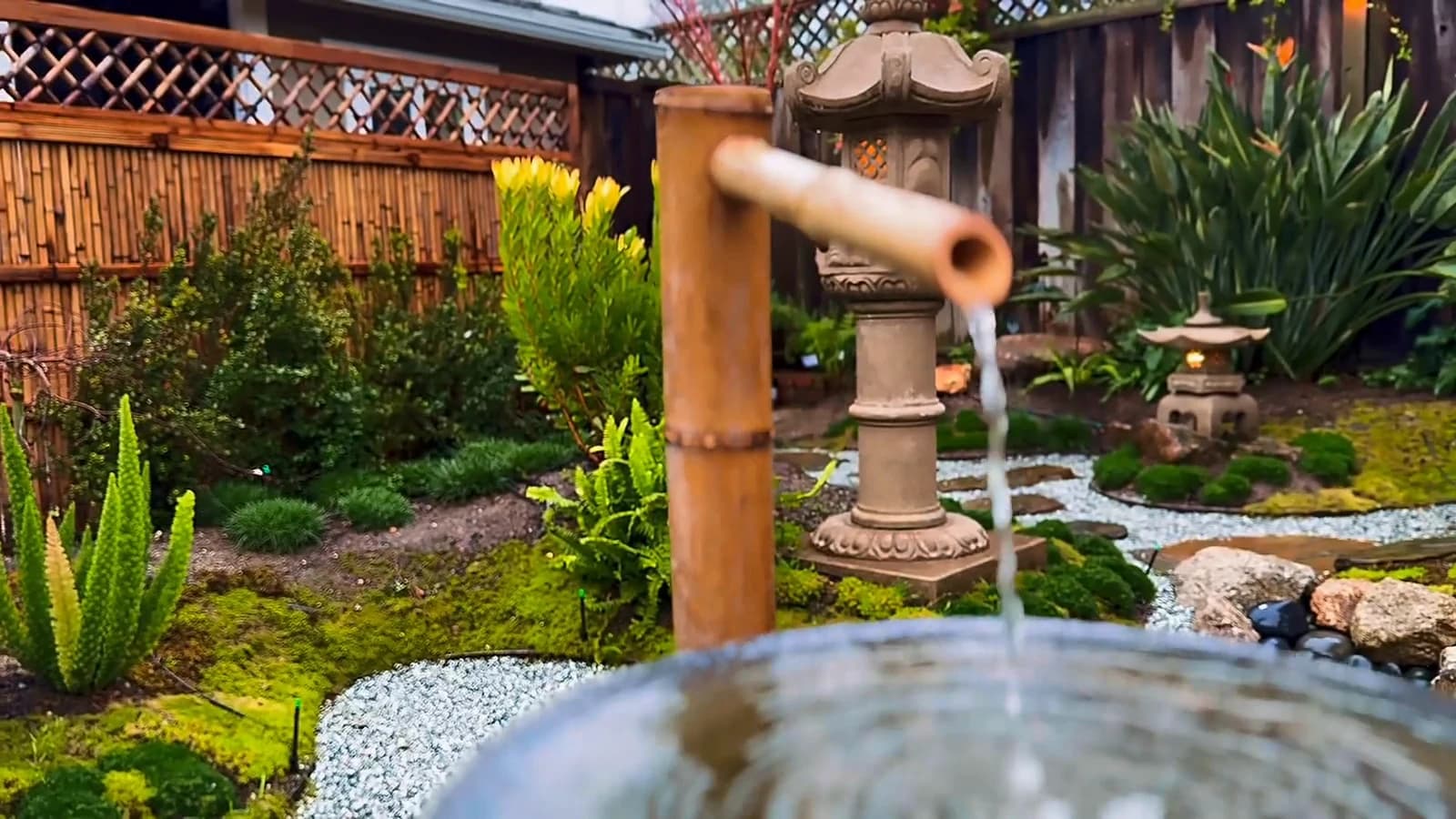
You do not need a pond. A stone basin (tsukubai) with a slow trickle, or a short rill into a hidden reservoir, gives the sound and the reflection for a fraction of the water and the maintenance. The visible part is small; the chamber, pump and overflow underneath are what we draw in section so the contractor gets it right the first time.
7. Enclosure and threshold: the garden starts at the gate
Japanese gardens are rooms. A fence, a hedge or a change of ground surface draws the edge, and a threshold (a gate, a step, a single large stone) marks the moment you enter. In California the fence is usually already there; the work is to make its inside face part of the composition, with a screen of bamboo or a dark stain and a planted edge, rather than leaving it as a property line.
Plants that take California summers
The Kyoto palette assumes humid summers and 60 inches of rain. Most of California gets a dry summer, hot afternoons, alkaline clay or sand, and water rules. The palette below keeps the forms the style needs (layered evergreens, one sculptural tree, a fine-textured ground plane) with species that will live here on drip irrigation. Check your own microclimate; a Berkeley hillside and a Sacramento lot are different places.
| Role in the garden | What we reach for in California | Notes |
|---|---|---|
| The sculptural tree | Japanese black pine (Pinus thunbergii), coast live oak if you have one, Western redbud, olive (fruitless) for a silver note | Pines take heat and wind and can be pruned into character over years. An existing oak is the best Japanese-garden tree in California; design around it and keep irrigation away from its trunk. |
| Japanese maple | Acer palmatum only in morning sun with afternoon shade, or under a canopy | In hot, exposed yards the leaves scorch. UC Master Gardeners advise siting them out of afternoon sun and watering deeply but not often; many “sunburned” leaves are a watering problem. |
| Clipped and layered evergreens | Dwarf pittosporum, Japanese holly (Ilex crenata), Podocarpus, manzanita (Arctostaphylos), Ceanothus, camellia and azalea in shade | Manzanita gives the twisted trunk and tight foliage the style wants with no summer water once established. Camellias need shade and acidic soil; treat them as a luxury. |
| The ground plane (instead of moss) | Native sedges (Carex pansa, C. praegracilis), deer grass (Muhlenbergia rigens), dymondia, Japanese forest grass only in shade, and gravel | Moss will not survive a California summer without constant misting. A sedge meadow mown twice a year reads as moss from across the garden; gravel does the rest. |
| Seasonal moments | Flowering cherry or plum, iris by the water, a single wisteria on the pergola | One or two, not a show. The point is that the garden changes a little each month. |
Two things we usually leave out: running bamboo, which escapes, and heavenly bamboo (Nandina), which is overused and self-seeds. Clumping bamboo (Bambusa, Fargesia in cooler spots) is the safe way to get the screen.
What it costs
Design
Our design packages are fixed-price: Back Yard $1,999, Front Yard $1,999, Full Yard $3,499, Small Space $999. Each includes the layout, 3D studies, planting and material direction, and a design review together. First design in 5–10 business days. Unlimited revisions until you love it — within the scope of your package. Everything is delivered online, anywhere in the United States or Canada.
Construction
Construction is quoted separately by the contractor who builds it. As a national benchmark, HomeAdvisor puts typical landscaping at $4.50–$12 per square foot and a full backyard renovation at $15,000–$50,000. A Japanese-inspired garden spends that money differently from a lawn-and-patio yard:
- Where the money goes: setting boulders and stepping stones, the water feature’s hidden chamber and plumbing, and any carpentry (a bridge, a gate, a bamboo screen). These are skilled hours.
- Where it is saved: gravel and decomposed granite instead of paving, a sparse planting plan instead of a full one, and no lawn to install or irrigate. Keeping existing trees saves the most.
- In the San Francisco Bay Area the garden can be built with licensed contractors we work with, from our drawings. Elsewhere, the design package is drawn so a local contractor can price and build it.
Rebates for taking out lawn
Because the style replaces lawn with gravel, stone and low-water planting, it usually qualifies for a lawn-conversion rebate. In Santa Clara County, Valley Water’s current base rate is $2 per square foot of converted lawn, and you must have written approval before any work starts. Most Bay Area water agencies run a similar program, and some cities add to it; we check your agency’s rules during design so the plan qualifies.
A worked example: The Quiet Crossing
An overgrown lawn under mature trees, with a pergola the owners liked. The design kept the canopy and the pergola, replaced the lawn with a sequence of gravel, planted islands and stepping stones, and added one timber bridge over a small water feature as the garden’s focal point. Nothing is centered on the house; you cannot see the bridge from the back door until you have walked a few steps.
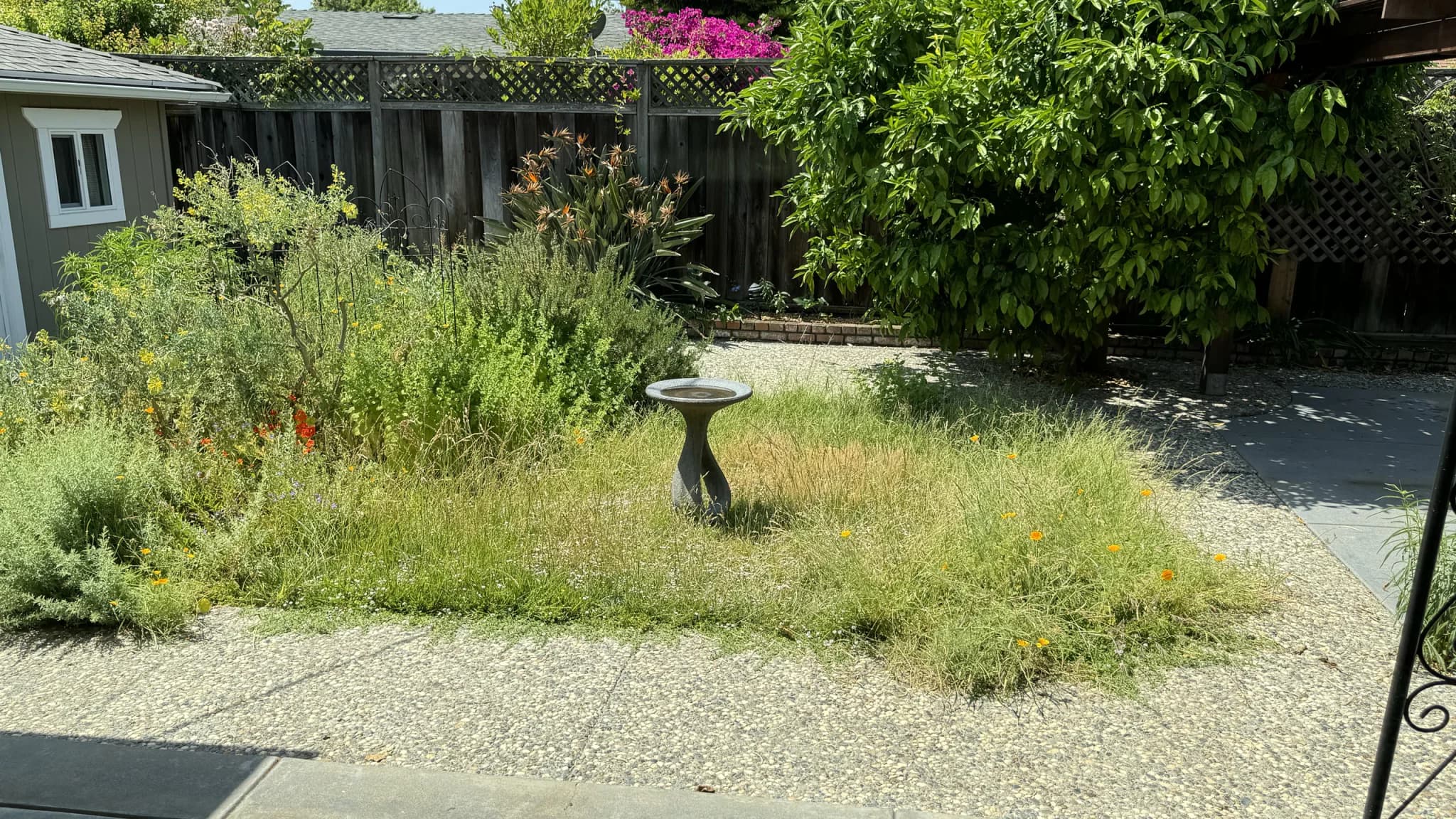
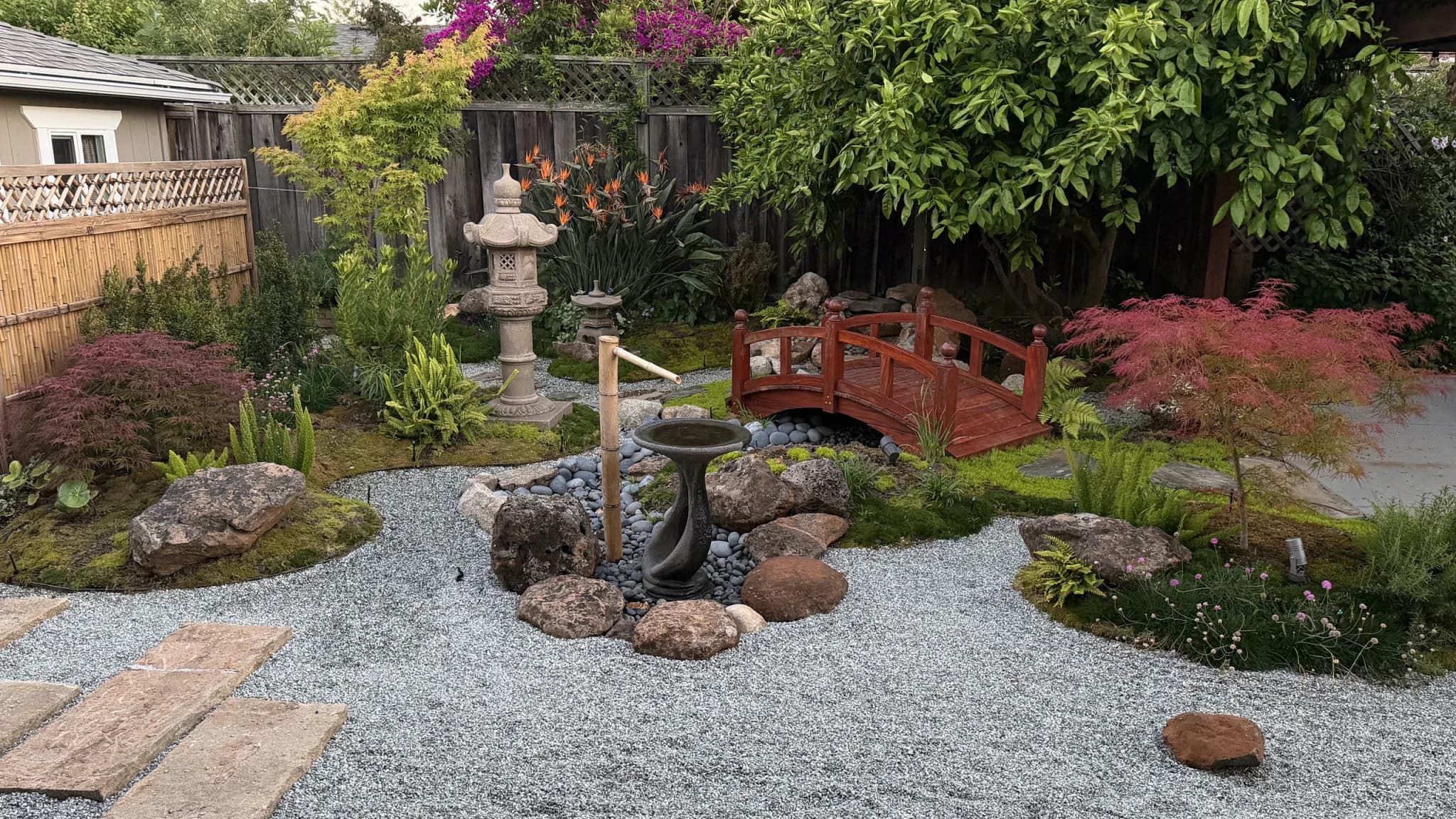
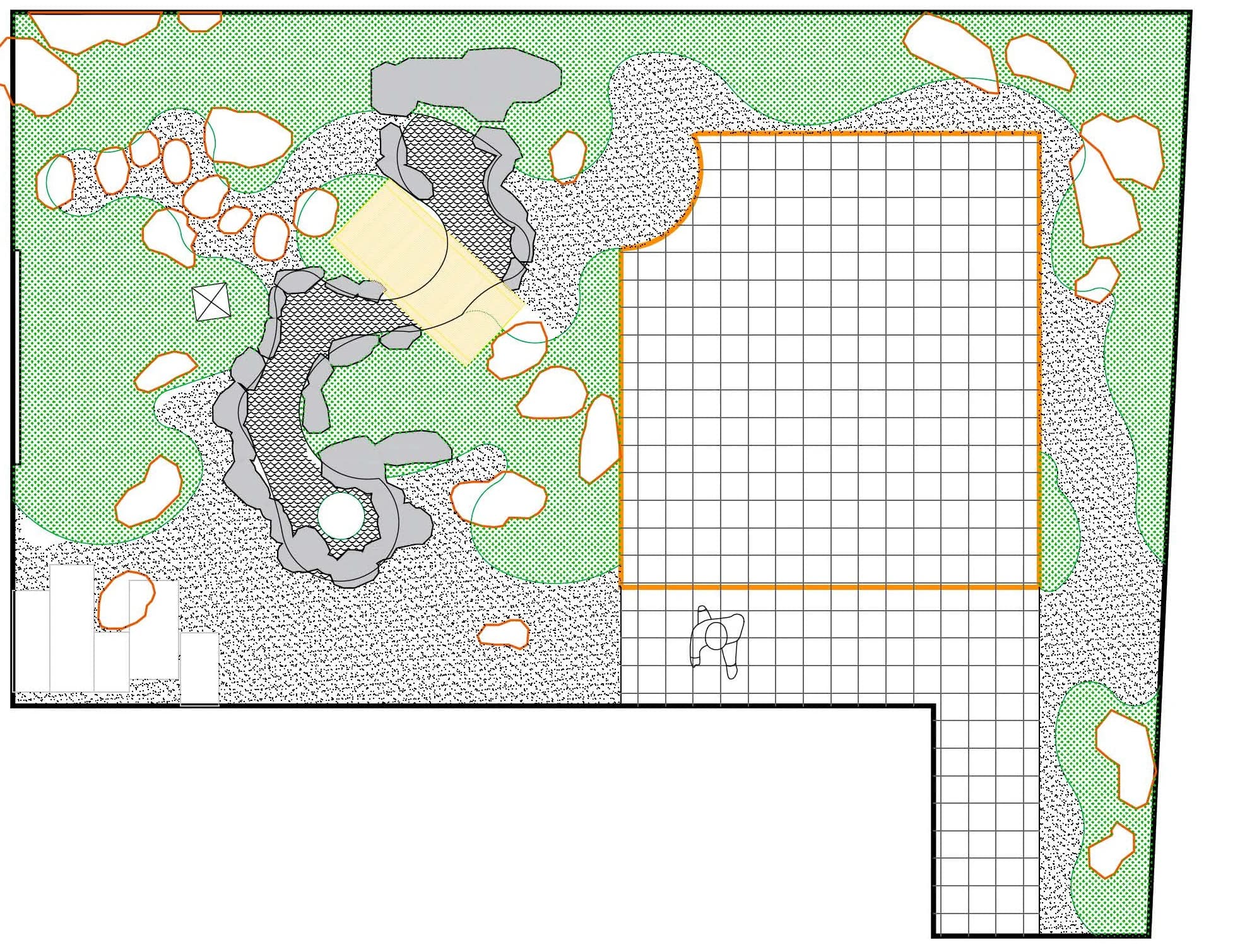
See the full project, including the water-feature section and the setting-out on site.
Questions people ask
- Does a Japanese-inspired garden need a lot of water?
- No. The look comes from stone, gravel, pruned evergreens and a small water feature, not from lawn. Planted with adapted and native species on drip irrigation, a Japanese-inspired garden usually uses less water than the lawn it replaces, which is why lawn-conversion rebates often apply.
- Can it work in a small California yard?
- Yes. The style was developed for small urban courtyards. Hide-and-reveal paths, enclosure and empty space make a compact space feel larger, and a single stone basin can stand in for a pond. Our Small Space package covers one courtyard, patio or compact garden.
- Do I need a Japanese maple?
- No. Japanese maples want morning sun and afternoon shade; in a hot, exposed California yard they scorch. A Japanese black pine, a manzanita or an existing oak can carry the composition instead, with maples reserved for sheltered, east-facing spots.
- Can you design a Japanese-inspired garden remotely?
- Yes. Peilin designs gardens online for clients across the United States and Canada, starting from your photos, measurements and a short quiz. In the San Francisco Bay Area the garden can also be built with licensed contractors.
START WITH YOUR SPACE
Tell us about your yard.
A short quiz about your space, then a design conversation with Peilin. Fixed-price packages from $999 for a courtyard to $1,999 for a backyard.
SOURCES
- UC Master Gardeners (UC ANR), "Japanese Maples": site them out of hot afternoon sun; most leaf scorch is a watering problem. ucanr.edu
- Valley Water (Santa Clara County), Landscape Conversion Rebate: base rate $2 per square foot of converted lawn, written approval required before work starts. valleywater.org
- HomeAdvisor, "How Much Does Landscaping Cost?" (updated June 2026): $4.50–$12 per square foot for typical landscaping; a full backyard renovation averages $15,000–$50,000. homeadvisor.com